Buying a Home in Today’s Market: Timing and Opportunity
-
 by Biazowa
- November 3, 2026
- Features, Market Trends

One of the most common questions prospective homebuyers ask is whether now is a good time to purchase a home. Some buyers are waiting for mortgage rates to decline, while others are hoping home prices will fall enough to make ownership more affordable. For many, the decision comes down to whether purchasing today is preferable to waiting for more favorable market conditions.
The challenge is that housing markets rarely move in a predictable direction. Mortgage rates can decline while home prices rise, and prices can soften even as borrowing costs remain elevated. Waiting may improve a buyer’s financial position, but it can also introduce new challenges, including increased competition and reduced negotiating leverage.
With mortgage rates above 7% and affordability remaining a concern, prospective buyers face difficult decisions. However, slower sales activity in certain markets has also created opportunities to negotiate purchase prices, closing-cost assistance, and financing incentives that may not have been available when competition was stronger.
For buyers considering a purchase, understanding these trade-offs is more valuable than attempting to identify the perfect time to enter the market.
The Challenge of Timing the Housing Market
Housing market conditions are influenced by mortgage rates, employment, household income, housing supply, economic growth, and consumer confidence. These factors interact in ways that make short-term price and interest rate movements difficult to predict.
When mortgage rates increase, borrowing becomes more expensive. Higher monthly payments reduce purchasing power, potentially forcing buyers to consider less expensive properties or postpone their purchases.
As demand weakens, homes may remain on the market longer, sellers may become more willing to negotiate, and price growth may moderate. In markets where available inventory exceeds buyer demand, prices may decline.
However, higher mortgage rates do not automatically lead to lower home prices.
Existing homeowners with low fixed mortgage rates may be reluctant to sell because purchasing another property would require taking on a substantially higher borrowing cost. This can constrain housing supply and support prices even when demand slows.
The reverse can occur when mortgage rates decline.
Lower borrowing costs improve purchasing power and may encourage buyers who previously postponed their purchases to reenter the market. If demand increases faster than available housing inventory, competition can intensify, potentially leading to higher prices and fewer opportunities for negotiation.
For buyers waiting for both substantially lower mortgage rates and lower home prices, these competing market forces can make the desired combination difficult to achieve.
That does not mean waiting is necessarily the wrong decision. It means that the financial consequences of waiting should be evaluated rather than assuming future conditions will be more favorable.
Why Financial Readiness Matters More Than Market Timing
For buyers planning to occupy a home for many years, the decision to purchase should begin with financial readiness rather than short-term market forecasts.
A home is both a significant financial commitment and a place to live. Unlike an investment property acquired primarily to generate returns, a primary residence also serves personal and household needs that may extend well beyond current market conditions.
Financial readiness involves more than qualifying for a mortgage.
Buyers should evaluate the stability of their income, available savings, existing financial obligations, anticipated ownership expenses, and ability to maintain adequate reserves after closing.
The monthly mortgage payment is only one component of homeownership. Property taxes, homeowners insurance, maintenance, utilities, and homeowners association fees, where applicable, contribute to the total cost of ownership.
A buyer who qualifies for a mortgage at the upper limit of their borrowing capacity may still find the resulting payment difficult to sustain comfortably.
The anticipated length of ownership also matters. Buyers who expect to relocate within a few years face different considerations than those planning to remain in a home for a decade or longer. Transaction costs, potential market fluctuations, and the time required to build equity can have a greater effect over shorter holding periods.
For financially prepared buyers with a long-term ownership horizon, attempting to predict the lowest possible mortgage rate or purchase price may be less important than securing a suitable property at a sustainable cost.
The appropriate time to purchase is when the buyer is financially prepared, the property meets their needs, and the acquisition terms support their long-term objectives.
Finding Opportunities in a Slower Housing Market
Although elevated mortgage rates create affordability challenges, they can also influence the balance of negotiating power between buyers and sellers.
When fewer buyers are actively competing for homes, sellers may face longer marketing periods and become more receptive to reasonable offers.
This can create opportunities for buyers who have secured financing, understand their purchasing capacity, and are prepared to act when a suitable property becomes available.

However, identifying a good opportunity requires more than finding a home with a reduced asking price.
Buyers should evaluate comparable sales, property condition, local inventory, days on market, and recent pricing activity. A property that has been listed for an extended period may offer room for negotiation, but it may also be overpriced, require substantial repairs, or have characteristics that limit buyer demand.
A price reduction does not necessarily establish that a property is being offered below market value.
The objective should be to determine whether the asking price is supported by comparable properties and whether the seller’s circumstances create an opportunity to negotiate favorable terms.
In some transactions, the greatest benefit may come from a lower purchase price. In others, negotiating assistance with closing costs or financing expenses may provide more immediate financial relief.
The most effective approach depends on the buyer’s available cash, financing structure, and long-term ownership plans.
Negotiating Seller Credits and Mortgage-Rate Buydowns
One of the potential advantages of purchasing in a slower market is the opportunity to negotiate seller concessions.
A seller concession allows the seller to contribute toward certain buyer expenses as part of the purchase agreement, subject to the applicable loan program and lender requirements.
These contributions may help cover eligible closing costs, prepaid expenses, or mortgage discount points used to reduce the buyer’s interest rate.
For example, rather than negotiating only a reduction in the purchase price, a buyer may request a seller credit that reduces the amount of cash required at closing or helps offset financing costs.
The financial benefit depends on how the credit is structured.
A permanent mortgage-rate buydown generally involves paying discount points upfront to secure a lower interest rate for the life of the loan. The buyer should evaluate the upfront cost against the expected monthly savings and anticipated length of time they will retain the mortgage.
A temporary mortgage-rate buydown reduces the effective payment during an initial period, often one or two years, before payments increase to the amount required under the original note rate.
While a temporary buydown can provide short-term payment relief, buyers must understand and be prepared to afford the full contractual mortgage payment once the temporary subsidy expires.
Seller credits also have limitations. The amount permitted depends on factors such as the loan program, down payment, occupancy type, and eligible closing expenses.
Additionally, seller concessions should not be viewed as free money. They form part of the overall negotiated transaction, and buyers should evaluate whether the purchase price and financing terms remain competitive.
A buyer who negotiates a substantial credit but pays an inflated purchase price may not necessarily secure a better financial outcome.
The goal is to evaluate the complete transaction rather than focusing exclusively on the size of the concession.
New-Construction Incentives and Builder Negotiations
New-home communities can offer another avenue for buyers seeking to offset elevated borrowing costs.
Unlike individual homeowners, builders often manage multiple properties within a development and may have construction schedules, inventory targets, and financing obligations that influence their pricing and incentive strategies.
To encourage sales, some builders offer closing-cost assistance, mortgage-rate buydowns, or other financing incentives, frequently through preferred lending partners.
These incentives may be particularly relevant for completed inventory homes or properties approaching completion.
A builder may prefer to offer financing assistance rather than substantially reduce the advertised purchase price, especially when lower recorded sales prices could affect the valuation of other homes within the community.
However, buyers should evaluate the full financial arrangement.
An advertised below-market mortgage rate may depend on using a designated lender, selecting a particular home, meeting financing requirements, or closing within a specified period.
Buyers should compare loan estimates, interest rates, annual percentage rates, lender fees, and total closing costs across available financing options.
They should also consider the property’s base price, lot premiums, upgrades, homeowners association expenses, and any special assessments that could affect the overall cost of ownership.
A generous financing incentive does not automatically make a new home a better value than a comparable resale property.
As with any acquisition, the decision should be based on the property’s market value, financing terms, and long-term affordability.
Understanding the Trade-Off Between Mortgage Rates and Home Prices
The relationship between mortgage rates and home prices is one of the most important considerations for buyers deciding whether to purchase now or wait.
Consider two hypothetical scenarios involving a buyer purchasing a home with a 20% down payment and a 30-year fixed-rate mortgage.
In the first scenario, the buyer purchases a $600,000 home at a mortgage rate of 7.24%, financing $480,000 after a $120,000 down payment. The resulting monthly principal-and-interest payment is approximately $3,271.
In the second scenario, the buyer waits for mortgage rates to decline to 6.00%. However, the home’s purchase price increases to $630,000. With a 20% down payment of $126,000, the buyer finances $504,000, resulting in a monthly principal-and-interest payment of approximately $3,022.
Despite paying $30,000 more for the home, the buyer who waits benefits from a monthly payment approximately $249 lower.
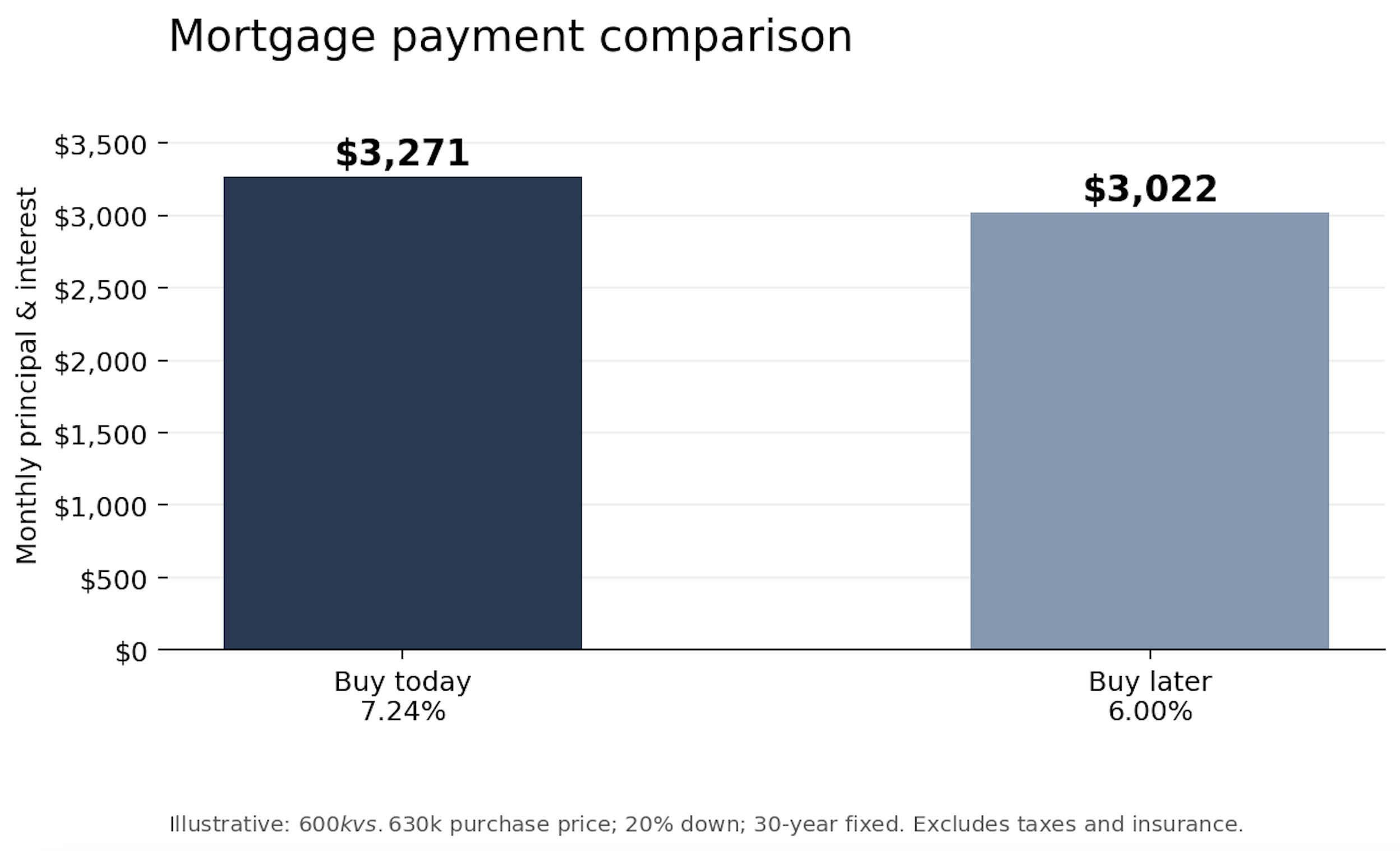
Illustrative comparison of monthly principal-and-interest payments at 7.24% and 6.00%, assuming a 30-year fixed-rate mortgage and 20% down payment. Excludes taxes, insurance, HOA fees, maintenance, closing costs, and seller concessions. Future rates and home prices are hypothetical, not forecasts.
However, that buyer also requires an additional $6,000 toward the down payment and acquires the property at a higher purchase price.
The buyer purchasing earlier commits less capital toward the down payment and may have greater opportunities to negotiate seller concessions, depending on market conditions.
Neither scenario is automatically superior.
The outcome depends on factors including the negotiated purchase price, available financing, ownership horizon, future property values, and the buyer’s financial circumstances.
It is also important to recognize that lower mortgage rates do not guarantee higher home prices. Local supply, employment conditions, household formation, and broader economic developments can influence housing values independently of interest rate movements.
Buyers should therefore avoid making purchase decisions based solely on the expectation that rates will decline or prices will appreciate.
Should Buyers Purchase Now or Wait?
There is no universally correct answer to whether purchasing today is better than waiting.
For some buyers, postponing a purchase may be the appropriate decision. Additional time can allow them to strengthen their savings, reduce debt, improve their credit profile, or establish greater income stability.
Others may already have the financial capacity to purchase but remain hesitant because they expect mortgage rates or home prices to decline.
For these buyers, the decision should involve evaluating the cost of purchasing under current conditions against the uncertainty of future market changes.
A slower housing market may provide negotiating opportunities that become less available if lower mortgage rates bring more buyers into competition for a limited supply of homes.
Conversely, purchasing before a period of declining prices could expose a buyer to a reduction in property value, particularly over a shorter ownership horizon.
The possibility of refinancing should also be approached carefully.
Although homeowners may be able to refinance if mortgage rates decline, refinancing depends on future lending conditions, borrower qualifications, property values, and transaction costs. Buyers should not rely on an anticipated refinance to make an otherwise unaffordable mortgage payment sustainable.
The more useful question is not simply whether mortgage rates will be lower next year, but whether purchasing a particular home today makes financial sense based on the buyer’s current circumstances.
Making an Informed Homebuying Decision
Elevated mortgage rates have made homeownership more challenging, but they have also changed the negotiating environment in certain housing markets.
Buyers who are financially prepared may find opportunities to negotiate purchase prices, request closing-cost assistance, explore mortgage-rate buydowns, or take advantage of builder incentives.
These opportunities do not eliminate the financial burden of higher interest rates, nor do they guarantee that purchasing today will produce a better outcome than waiting.
They do, however, demonstrate why housing market conditions should be evaluated beyond mortgage rates alone.
A successful home purchase depends on understanding local market dynamics, assessing the property’s value, comparing financing options, and negotiating terms that support sustainable ownership.
For buyers planning to remain in their homes over the long term, financial readiness and the quality of the acquisition may ultimately matter more than attempting to predict the next movement in mortgage rates or home prices.
The objective is not to purchase at the theoretical bottom of the market, but to make an informed decision that aligns with the buyer’s financial capacity, housing needs, and long-term plans.